Ethical & Privacy Preserving AI Systems
Privacy-first inference and trustworthy deployment
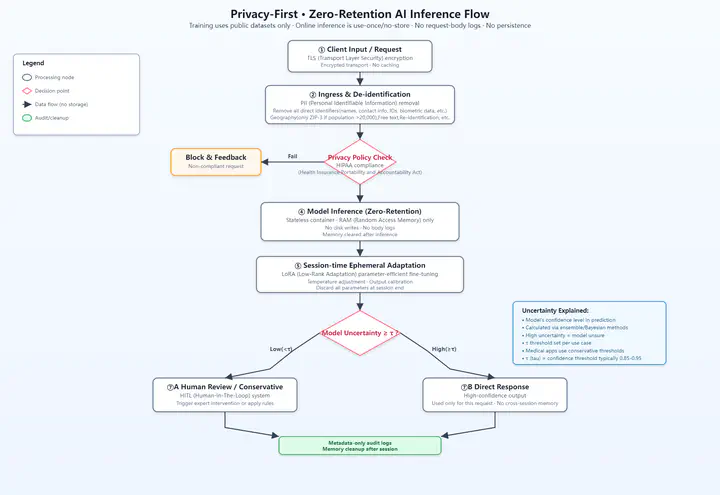 Privacy Preserving AI Systems
Overview
Ethical and Privacy Preserving AI Systems prioritize data protection and trustworthy deployment, ensuring AI benefits society while respecting individual privacy rights.
Key Features
- Privacy-First Design: Built-in privacy protection from the ground up
- Secure Inference: Protected model execution without exposing sensitive data
- Federated Learning: Distributed training without centralizing data
- Zero-Retention: No persistent storage of sensitive information
Applications
- Analytics: Privacy-preserving data analysis
- Deployment: Secure model distribution and execution
- IoT: Federated learning for edge devices
- Healthcare: Protected health data pipelines
Deliverables
- Privacy-First and Zero-Retention AI Inference Flow
- Federated Learning Framework
- Secure Model Deployment Tools
Principles
Our approach is grounded in ethical AI principles:
- Transparency: Clear communication about data usage
- Fairness: Equitable treatment across populations
- Accountability: Responsible AI development and deployment
- Privacy: Strong protection of individual data rights
Impact
These systems enable organizations to leverage AI while maintaining the highest standards of privacy and ethics.

Lu Wang
Assistant Professor of Biomedical Engineering
My research interests are developing and applying Machine Learning, Data Mining and Statistical methods (e.g., Multi-task Learning, Survival Analysis, Clustering, Risk Factor Analysis and Causal Discovery) on various data including gene expression, electronic health/medical records, and DNA sequencing reads for both cognitive disorders (e.g., delirium, Alzheimer’s disease, dementia, major depressive disorder) and chronic diseases (e.g., cancer, obesity, hypertension). Inspired by the human factors approach, she also designs and develops Human-Centered Artificial Intelligence tools for users to integrate, visualize, analyze, and interpret health data in order to improve the interoperability and accessibility of AI-assisted healthcare decision support.